
Allendale Township City Directory Holdings
No complete Allendale-specific city-directory run was located in the reviewed official sources. The practical shelf is regional: Ottawa Countywide books, nearby Grand Haven and Holland volumes, and Polk or Bresser/criss-cross formats at state and local repositories. Search the original heading as printed. A record filed under Grand Haven, Holland, Zeeland, or Ottawa County can be a valuable lead, but its heading does not redraw the township boundary or establish a household location.
| Collection | Years | Where Held | Access |
|---|---|---|---|
| Ottawa Countywide directories | 1903-1921 | Regional genealogy-library lead | Verify volume and entry |
| Grand Haven city directories | 1936, 1938, 1941-1960 selected years | Regional and library collections | Repository or database access varies |
| Holland directories | 1903-1921 and 1929-1960 selected years | Regional holdings | Check exact city heading |
| Polk and Bresser/criss-cross volumes | Late 1800s and later | Library of Michigan | Print, microfilm, listed databases |
| Loutit local-history collection | Atlases 1849, 1876, 1897, 1912, 1930 | Loutit District Library | Collection-specific access |
Directory dates have gaps. Rural coverage can be thin, and no source supports treating a nearby-city volume as a complete Allendale household roll. Preserve the volume, page, year, and repository with every finding.
Allendale Township Historical Geography
Allendale’s older names and changing boundaries explain why historical directory searches need more than one spelling. Local history uses Malta and Allandale as earlier names, while Zeeland separated in 1851 and Blendon in 1854. A historical Allendale label can therefore refer to a broader or different place than the modern township. Search Allendale Charter Township, Allendale Township, Ottawa County, Malta, and Allandale, then keep the source wording in the research note.
The Library of Michigan city-directory guide describes holdings by city or county. Print books are on the second-floor South shelves, while microfilm and fiche are in the second-floor South Microfilm Room. Its ANSWER catalog supports a city-directory search, and state gazetteers extend broadly from the mid-1860s through 1931/32. Some material is online through listed databases; other volumes require an in-person visit.
Note: A historical place heading documents the publisher’s filing choice, not a modern township boundary.
Reading Allendale Township Historical Entries
An Allendale city directory result needs to be read as a format, not as a profile. Polk surname entries may show a name, occupation, other household members, ownership marker, street address, telephone, and classified context. Later Bresser/criss-cross books turn the view around: they can arrange street addresses in house order and note the head of household, telephone, owner/renter marker, first appearance, relocation, or a building listing. Not every book prints every field.
| Name as printed | Record spelling, initials, and the exact entry form. |
|---|---|
| Address or street order | A dated address lead that may be a subscriber or head of household. |
| Household notation | Other named people or an owner/renter indicator, when the volume provides one. |
| Phone or business detail | A publication-era clue, not a current contact record. |
| Place and citation | City heading, volume year, page, directory type, and repository. |
- Criss-cross directory
- The street-order part of a later directory, often arranged by address rather than surname.
- Householder index
- An index centered on the listed head of household or subscriber, not a complete household census.
- Abbreviation key
- The volume’s own guide to its symbols and shortened words; read it before interpreting a mark.
Allendale Township Research at Loutit
Loutit District Library Local History & Genealogy serves Grand Haven, Spring Lake, Ferrysburg, and the broader Northwest Ottawa County area. Its local collection includes Grand Haven Tribune birth, marriage, and obituary indexes; maps and atlases; oral histories; archival material; and the Northwest Ottawa County Encyclopedia. The encyclopedia is arranged through people, buildings and sites, businesses and industries, and topics. A building or road entry can be a useful way to locate an old place name before a surname search.
Local-history hours listed by the library are Monday 9:00-5:00, Tuesday 2:00-7:00, Wednesday through Friday 9:00-5:00, and the first and third Saturday 10:00-2:00. Staff assistance is listed at 616-850-6925. Requests may be made by email, mail, or fax, but fragile items can be in-house only and lengthy remote research may carry a fee before delivery.
Use a narrow request: an old name, street, approximate year, and the question being tested. That gives staff a way to check a directory, newspaper index, atlas, or oral-history lead without guessing at a broad household list.
Loutit’s local-history landing page is pictured below. Its research and appointment routes are a documented alternative when a directory volume is not online.
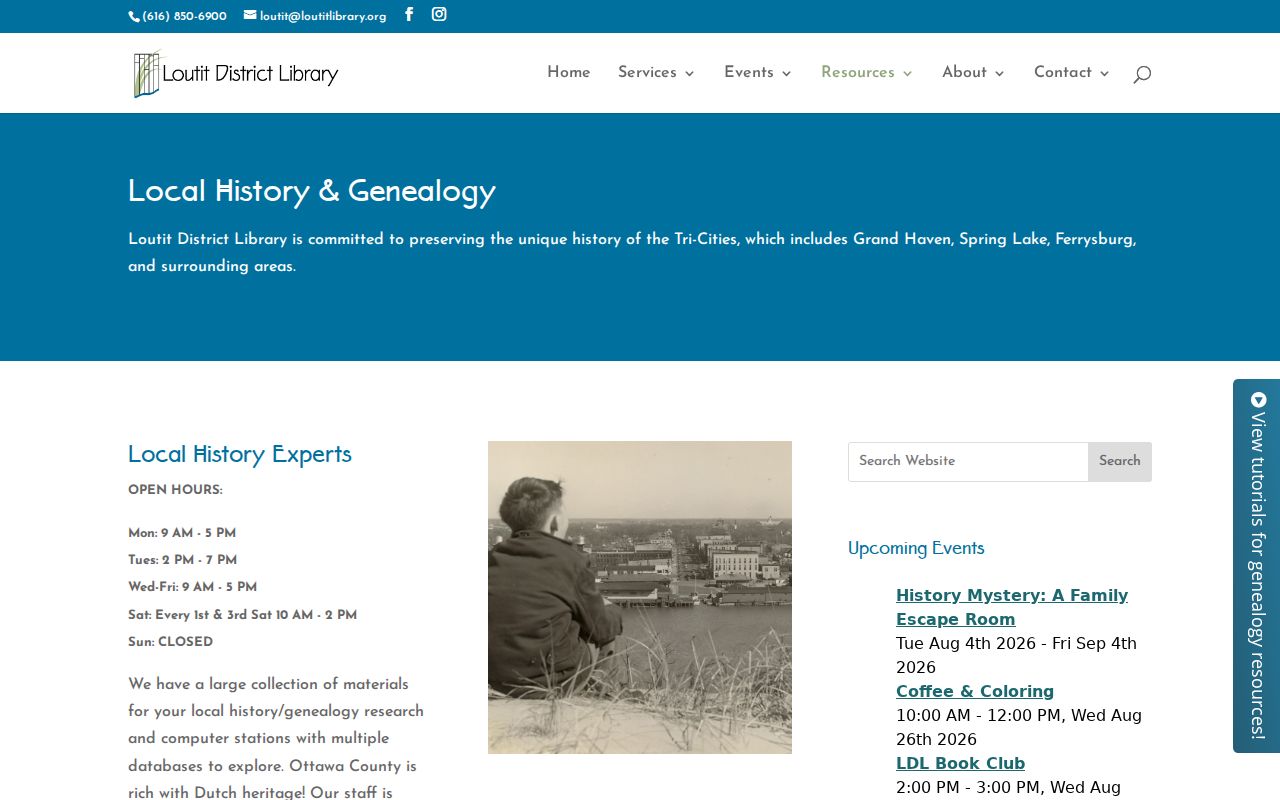
The collection supports a local-history trail, while the original volume or archival item remains the evidence for a specific entry.
Allendale Township Historical Formats
Polk and Bresser books answer different questions. Polk is often useful for surname, household, street, phone, and classified searching in late-nineteenth- and early-twentieth-century coverage. Bresser/criss-cross material is later, including late-1960s material, and can support street or house-order work. For Allendale, both are regional sources rather than proof of a complete township run.
A good citation distinguishes a surname entry from a street section. It also separates a printed address from a present parcel label. When an older address needs a current property context, the address-keyed work belongs in the Allendale street directory.
Trace Allendale Township Households
Use a city directory as a year-by-year trail. The aim is to test a documented identity across independent records, not to fill a gap with a similar name. Start with the first clear appearance, then repeat the search in the next available volume. Compare the printed address with a parcel or legal description only after recording the directory’s own street form and place heading.
- Copy the name and spelling exactly as the volume prints it.
- Record year, page, city or county heading, and directory format.
- Check the surname index and, where present, the street or phone-number index.
- Follow the entry through later available volumes and record moves or changed markers.
- Pair the directory year with census-era, atlas, newspaper, cemetery, or deed evidence.
- Label the result as a subscriber, head of household, owner, business, or event participant only when the source supports that role.
A disappearance may reflect a move, death, an unlisted number, a changed heading, or missing coverage. It does not prove a single explanation. The Grand Haven Tribune and Holland Evening Sentinel indexes can provide dated event leads, while cemetery records document burial rather than residence.
Allendale Township Historical Companions
GVSU is an important Allendale research path. The university’s archives hold administrative, faculty, student, organization, photograph, publication, audio, video, paper, and digital material. Digital selections are not comprehensive; physical material is available through Special Collections at Seidman House when a search result points beyond the web. The campus site was selected in 1961, which helps explain why a local historical subject may appear in university publications rather than a township directory.
The Allendale Township Library, at 6175 Library Lane, is a local referral point for community history and genealogy questions. The Allendale Historical Society preserves two historic homes, exhibits, and educational programs. Neither source publishes a complete surname index, so contact them with a specific local-history question instead of assuming a searchable roster exists.
The Allendale Historical Society’s public holdings description is shown below. It points to a repository and interpretive context, not a list of township households.
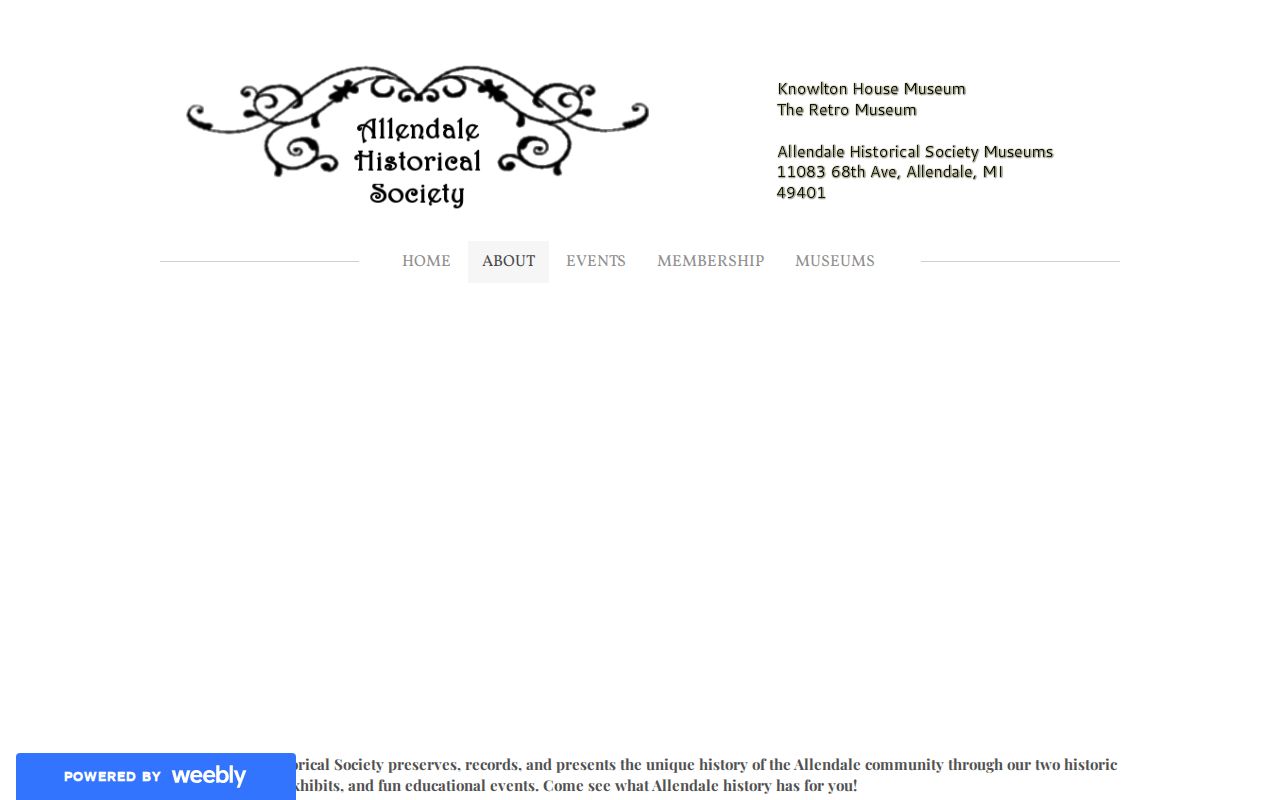
A society inquiry works best when it names the person, building, road, or period that the historical material should help place.
Allendale Township Historical Time Markers
Allendale’s record trail has several useful anchors: organization under Michigan’s 1849 public-acts framework, the Malta and Allandale name variants, the 1851 and 1854 boundary changes, the 1917 Eastmanville Bridge, and GVSU’s 1961 site selection. They help a researcher decide whether a county history, road, campus publication, or regional directory is likely to use a different geographic name.
- 1849: Allendale Township was organized, and local history places the first meeting at Richard Roberts’s home.
- 1851 and 1854: Zeeland and Blendon separated, changing the historic geography behind some labels.
- 1903-1921: Located Ottawa Countywide directory years provide a county-level lead.
- 1961: GVSU selected its Allendale site, expanding the university publication and archive trail.
Population snapshots also show why methods differ. Local sources cite 168 in 1850, roughly 1,100 in 1882, 20,708 in 2010, and 26,582 in 2020. Those figures describe periods, not the coverage or accuracy of a specific directory.
Allendale Township Historical Access Paths
Use the online catalog and digital databases first when the needed year is known. If the volume is not digitized, the alternatives documented in local research are Loutit staff assistance, the Library of Michigan’s print or microfilm rooms, GVSU Special Collections, Archives of Michigan county guides, and the Allendale Historical Society. Each has a different access rule. An online index is a finding aid, while an original page, scan, or repository response is the item to cite.
Michigan’s city-directory collection guide is pictured here. Its Polk and criss-cross descriptions are useful for choosing the right format before asking a library to pull a volume.
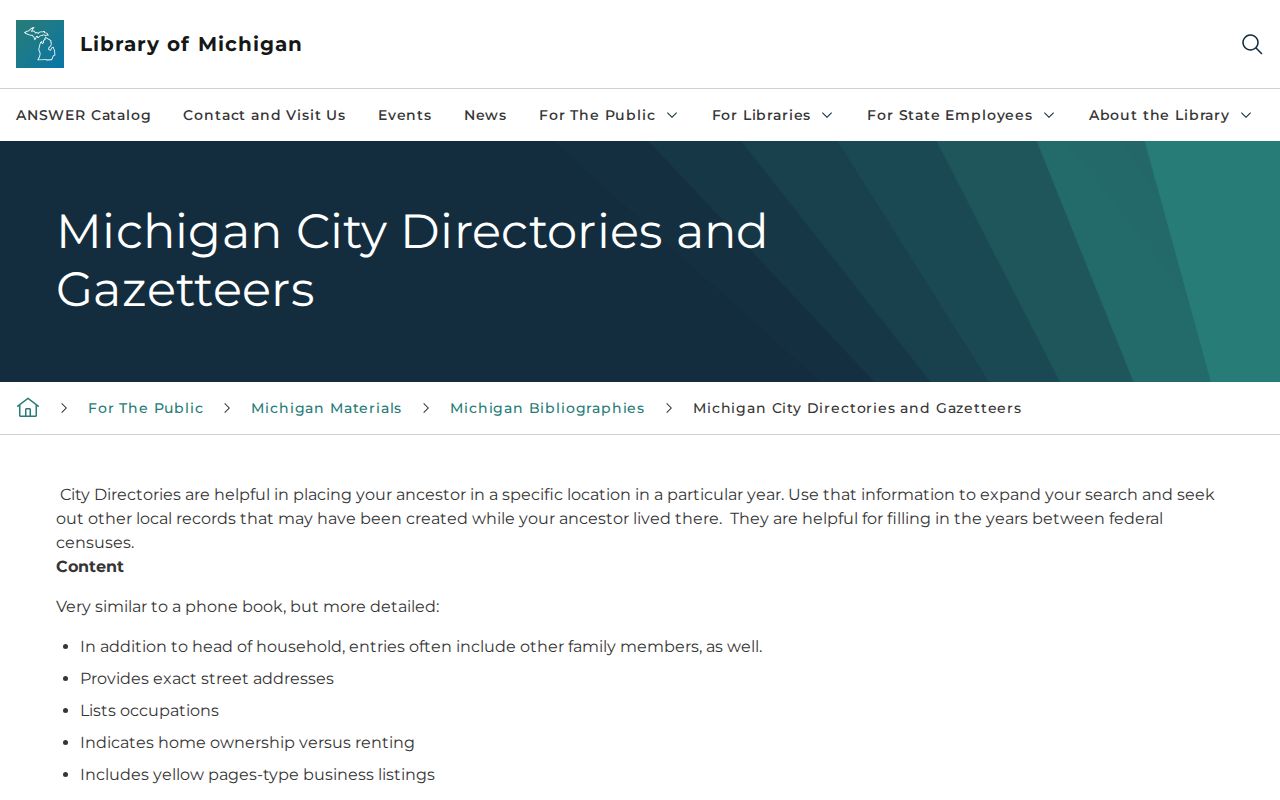
Record any access limit, library-login condition, or missing-year gap beside the citation so another researcher can repeat the route.
Allendale Township Historical Limits
City directories do not prove current residence, ownership, family relationship, or every person at an address. A printed entry can describe a phone subscriber, a head of household, a business contact, or a historical subject. Newspapers, atlases, and obituaries have their own editorial and date limits. A cemetery entry documents burial context, not a person’s full residential history.
Keep protected addresses and confidential records out of any search trail. If two entries conflict, retain both citations and ask the custodian or repository about the original source rather than forcing a match. Historical work is strongest when the result states its date, jurisdiction, record type, and remaining uncertainty.
Note: Missing from a directory can mean missing coverage, an alternate heading, or a different publication practice.